The Punic Wars
Rome vs. Carthage: The Struggle for the Mediterranean
From 264 to 146 BCE, three brutal wars shaped the future of Western civilization, ending with the total destruction of Carthage and the rise of the Roman Republic as the undisputed master of the sea.
Background: Two Emerging Powers
By the 3rd century BCE, the Roman Republic had unified Italy, while the Carthaginian Empire controlled a vast maritime trade network centered in North Africa. The clash for control of Sicily, a strategically vital island, was the inevitable spark that ignited the first conflict. The Punic Wars are named after the Latin word *Poenicus*, meaning 'Carthaginian' (referring to their Phoenician ancestry).
Timeline of Conflict
- First Punic War: Naval Supremacy
Primarily a naval war fought over control of Sicily. Rome, a land power, rapidly built a navy and secured victory, gaining its first overseas province.
- Second Punic War: Hannibal's Campaign
Famous for Hannibal Barca's crossing of the Alps and his stunning victories. Rome persevered and ultimately defeated him.
- Third Punic War: The Destruction of Carthage
A final, short war initiated by Rome to eliminate Carthage as a perceived threat, ending with the city's total destruction.
Key Military Leaders
Cato the Elder
Roman statesman and Senator who was the driving force behind the Third Punic War, constantly demanding the destruction of Carthage.
Major Battles
Battle of Cannae (216 BCE)
A catastrophic Roman defeat in the Second Punic War, where Hannibal's tactical masterpiece resulted in the encirclement and slaughter of over 50,000 Roman soldiers.
Battle of Zama (202 BCE)
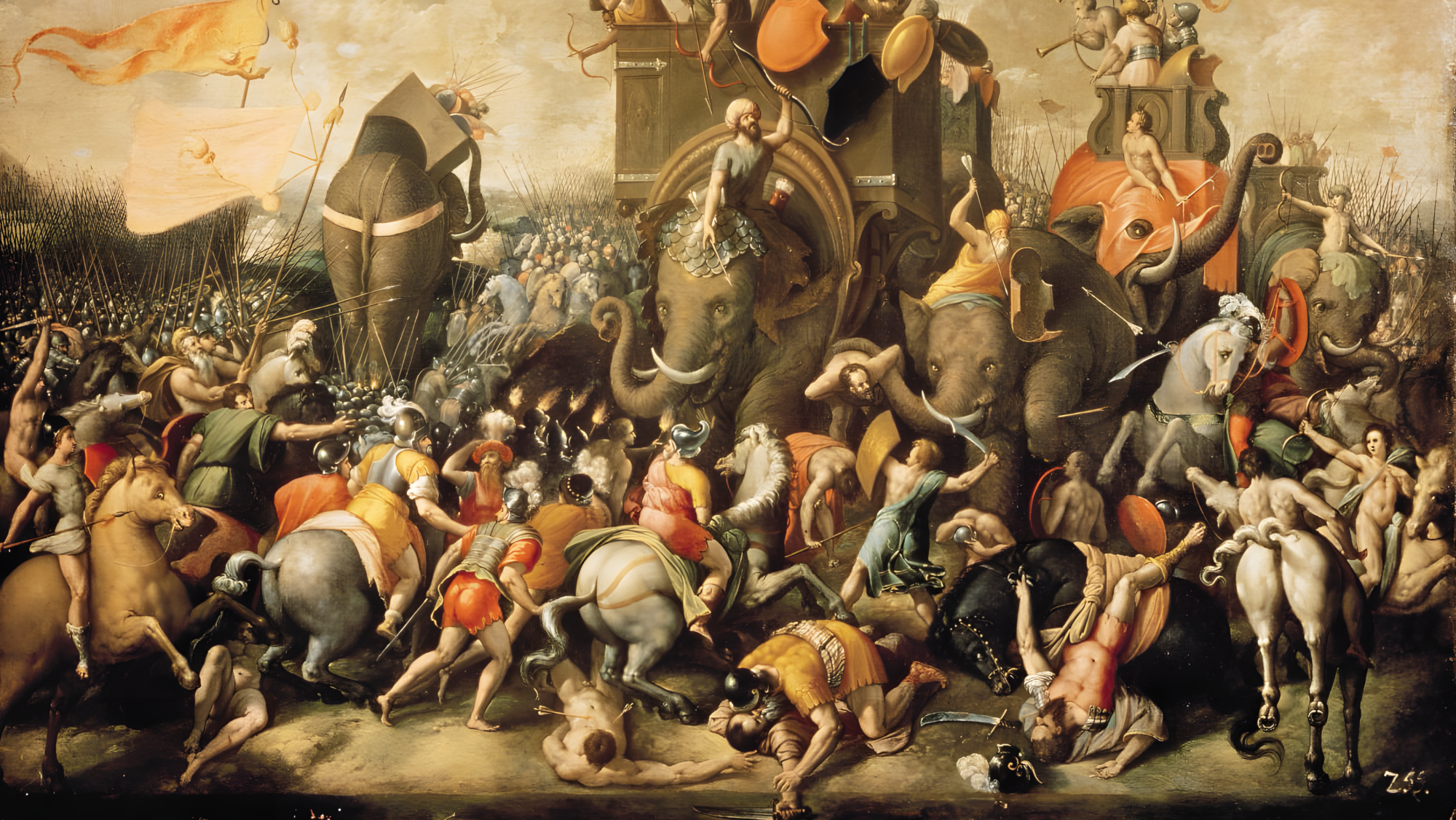
The final battle of the Second Punic War, fought in North Africa. Scipio Africanus's cavalry maneuvers proved superior, leading to Hannibal's first and final major defeat.
Siege of Syracuse (212 BCE)
A protracted siege known for the defense mechanisms devised by the great mathematician Archimedes, who was killed when the city finally fell to Rome.
Did You Know?
- The Roman Navy developed the 'Corvus' (Crow), a boarding bridge, to turn naval battles into land battles, leveraging their superior infantry.
- After the destruction of Carthage in 146 BCE, Roman tradition claims they plowed salt into the soil, though historians dispute this as historical fact.
- The war elephants used by Hannibal were smaller North African forest elephants, not the larger Indian elephants.
- The Second Punic War saw the invention of the famous phrase: 'Hannibal ad portas!' (Hannibal at the gates!), shouted in panic in Rome.